DN2026.pdf

Page 1 / 9

BUILT BY DENNIS DN2026 DNDS001C – JULY 2026 – REVISED OCTOBER 2026

DN2026 Solo, Local-First Software Builder With EEG Input and Console-Repair Capability

1Features

  • Builds complete tools alone, from empty repository to release
    • 8 open-source projects on GitHub, all but one under MIT, Apache-2.0 or GPL-3.0
    • OpenTime: 3 versioned releases in 8 days
  • Motor-imagery EEG decoding, reported on held-out data
    • 80% on a held-out run, against 97.8% from shuffled cross-validation
  • Local-first by default
    • No account or subscription in Cvideo, OpenTime, Pixel Companion or sudoku-race
  • Targets Windows desktop (Electron), Chrome (Manifest V3) and Cloudflare Workers
  • Game console repair and modding

2Applications

3Description

I'm Dennis, a high school student who builds software on my own. The nine projects in Section 7 are the ones I can show; eight of them are open source and linked to their code.

Away from the keyboard I repair and mod game consoles. Next is electrical engineering, and First Principles, an electronics workbench, is where that starts.

Device Information

Part numberPackageStatus
DN2026High school studentActive
BUILT BY DENNIS DN2026 DNDS001C – JULY 2026 – REVISED OCTOBER 2026

Table of Contents

  1. 1 Features 1
  2. 2 Applications 1
  3. 3 Description 1
  4. 4 Revision History 2
  5. 5 Pin Configuration and Functions 3
  6. 6 Specifications 4
  7. 6.1 Absolute Maximum Ratings 4
  8. 6.2 Recommended Operating Conditions 4
  9. 6.3 Measured Characteristics 4
  10. 7 Application Information 5
  11. 7.1.1 First Principles 5
  12. 7.1.2 NeuroBrain 5
  13. 7.1.3 Cvideo 6
  14. 7.1.4 OpenTime 6
  15. 7.1.5 Forgey 6
  16. 7.1.6 Transcript Snatcher 7
  17. 7.1.7 NestFolders 7
  18. 7.1.8 Pixel Companion 8
  19. 7.1.9 sudoku-race 8
  20. 8 Device and Documentation Support 9

4Revision History

Dates are taken from the GitHub repositories. Page numbers refer to the current revision.

Changes from Revision B (September 2026) to Revision C (October 2026)

Changes from Revision A (August 2026) to Revision B (September 2026)

Changes from Original (July 2026) to Revision A (August 2026)

Original (July 2026)

BUILT BY DENNIS DN2026 DNDS001C – JULY 2026 – REVISED OCTOBER 2026

5Pin Configuration and Functions

Each pin is a skill or tool. Pins marked P are power: ground is the hardware work, and supply is covered in Section 6.1.

DN2026TS1PY2JS3ELEC4MV35CFW6ARD7GND8EEG9DSP10LLM11AGNT12VID13TEST14NC15VCC16
Figure 1. DN2026 16-Pin DIP, Top View

Hover, tap or tab to a pin to trace which projects it connects to.

Table 1. Pin Functions

No.NameTypeDescription
1TSI/OTypeScriptUsed by First Principles, Cvideo, OpenTime, Forgey, Pixel Companion, sudoku-race
2PYIPython: EEG decoder, video backendUsed by NeuroBrain, Cvideo
3JSI/OJavaScriptUsed by NeuroBrain, Transcript Snatcher, NestFolders
4ELECOElectron desktop appsUsed by OpenTime, Forgey, Pixel Companion
5MV3OChrome extensions, Manifest V3Used by Transcript Snatcher, NestFolders
6CFWOCloudflare WorkersUsed by sudoku-race
7ARDI/OArduino and circuit simulationUsed by First Principles
8GNDPGround. Game console repair and modding
9EEGIMotor-imagery EEG inputUsed by NeuroBrain
10DSPISignal processing and classical ML (CSP + LDA)Used by NeuroBrain
11LLMI/OLanguage models: grounded answers, clip picking, optional local modelUsed by Cvideo, Pixel Companion
12AGNTOCoding agents: Claude and Codex CLIsUsed by Forgey
13VIDOVideo: faster-whisper, OpenCV face tracking, ffmpegUsed by Cvideo
14TESTIAutomated tests: jsdom and headless Chromium, VitestUsed by NestFolders, Pixel Companion, OpenTime
15NC-No connection yet. Reserved for electrical engineering
16VCCPSupply. See note (2) under Absolute Maximum Ratings
  • I = input, O = output, I/O = both, P = power, - = no connection.
BUILT BY DENNIS DN2026 DNDS001C – JULY 2026 – REVISED OCTOBER 2026

6Specifications

6.1Absolute Maximum Ratings(1)

Table 2. Absolute Maximum Ratings

ParameterMinMaxUnit
The word "impossible", in working vocabulary(2)0words
Accounts required to use Cvideo, OpenTime, Pixel Companion or sudoku-race0accounts
Subscriptions required by the same four tools0USD/month
  1. (1)Operation beyond these ratings has not been attempted and is not planned.
  2. (2) "Impossible is a word to be found only in the dictionary of fools." Napoleon Bonaparte

6.2Recommended Operating Conditions

Table 3. Recommended Operating Conditions

ParameterMinNomMaxUnit
Team size11-people
Development host-Windows 11 + WSL-

6.3Measured Characteristics

Taken from each project's README. The transcript timings there are approximate; the EEG figures are measured on public PhysioNet recordings.

Table 4. Measured Characteristics

ParameterTest conditionsMinTypMaxUnit
NeuroBrain Section 7.1.2
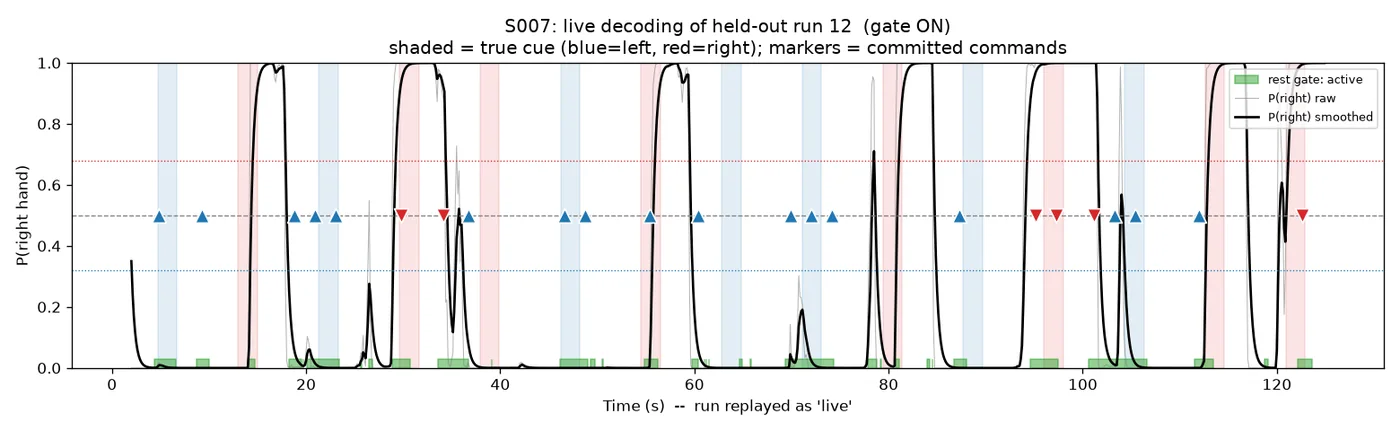
Decode accuracy, held-out run PhysioNet S007, run 12 replayed livePhysioNet S007, run 12 replayed live80%
Decode accuracy, shuffled 5-fold CV(3) Same model, same subjectSame model, same subject97.8%
Within-cue accuracy, rest gate on S007, held-out runS007, held-out run89%
False triggers, rest gate off S007, held-out runS007, held-out run26.5/min
False triggers, rest gate on S007, held-out runS007, held-out run8.8/min
Mean accuracy across subjects(4) Subjects 1-20, 5-fold CV; chance 51%Subjects 1-20, 5-fold CV; chance 51%57.2%
Transcript Snatcher Section 7.1.6
Transcript fetch time per video Fastest working method to hidden-tab scrapeFastest working method to hidden-tab scrape0.716s
Cvideo Section 7.1.3
Clip score Per candidate momentPer candidate moment0100pts
Pixel Companion Section 7.1.8
Sprite body / face size Hand-authored character gridsHand-authored character grids16 × 16 / 12 × 5px
  1. (3)Shuffled cross-validation lets trials from the same recording run land in both training and test sets. It is listed to show the gap; the held-out figure is the honest one.
  2. (4)Only 2 of 20 subjects cleared 75%. Reporting the full spread rather than the best subject is deliberate.
BUILT BY DENNIS DN2026 DNDS001C – JULY 2026 – REVISED OCTOBER 2026

7Application Information

Section 7.1 describes the nine projects this datasheet covers, strongest first. Open-source projects link to their code.

7.1Typical Applications

7.1.1 First Principles: An open-source electronics workbench

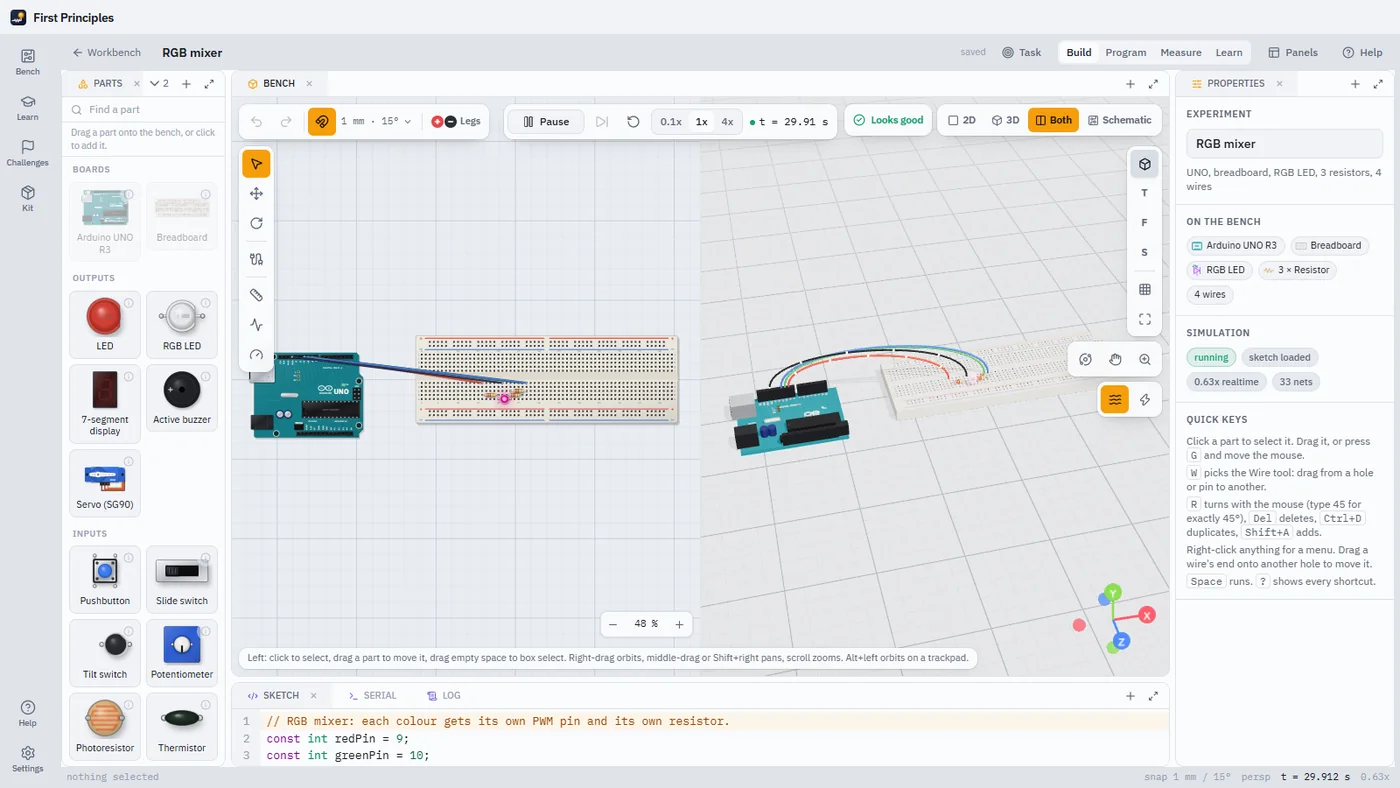
Build a circuit on a breadboard in 2D, in 3D or as a live schematic, all three views of the same circuit, and run real Arduino sketches on it. A multimeter, a four-channel oscilloscope and a serial monitor let you probe any point.

Under it is a real circuit solver (modified nodal analysis with diode and LED models) and a damage model, so parts really do burn out, and one undo brings them back. A circuit check flags shorts, LEDs without resistors and parts wired backwards, with the reason and the fix. Lessons sit beside the bench, so you read about Ohm’s law and then measure it. No AI in the core: the same circuit always gives the same numbers.

Licence
GPL-3.0
Opened
2026-10-17
Stack
TypeScript, Circuit simulation, Arduino
The First Principles bench showing an RGB LED circuit on an Arduino and breadboard, in 2D and 3D side by side, with the parts bin and sketch editor.
Figure 2. An RGB LED Sketch Running in 2D and 3D Side by Side

7.1.2 NeuroBrain: Motor-imagery EEG speller

Decodes imagined left- and right-hand movement from EEG and uses it to drive an on-screen speller, the kind of switch-access tool used by people with ALS or locked-in syndrome. The same speller also takes a hand gesture, a blink or a key press.

The decoder is CSP features into an LDA classifier, with a separate "rest gate" on motor-cortex band power so it stops firing commands while the user is idle. The EEG side runs on recorded PhysioNet data replayed in real time; there is no headset yet. Measured results are in Section 6.3, including the ones that look worse.

Licence
MIT
Opened
2026-08-04
Stack
Python, JavaScript, EEG
Live decoding trace of a held-out EEG run: the classifier output swings between left and right imagery cues, with the rest gate suppressing false commands between them.
Figure 3. Held-Out Run 12, Subject S007, Replayed Live With the Rest Gate On
BUILT BY DENNIS DN2026 DNDS001C – JULY 2026 – REVISED OCTOBER 2026

7.1.3 Cvideo: Long video to vertical clips

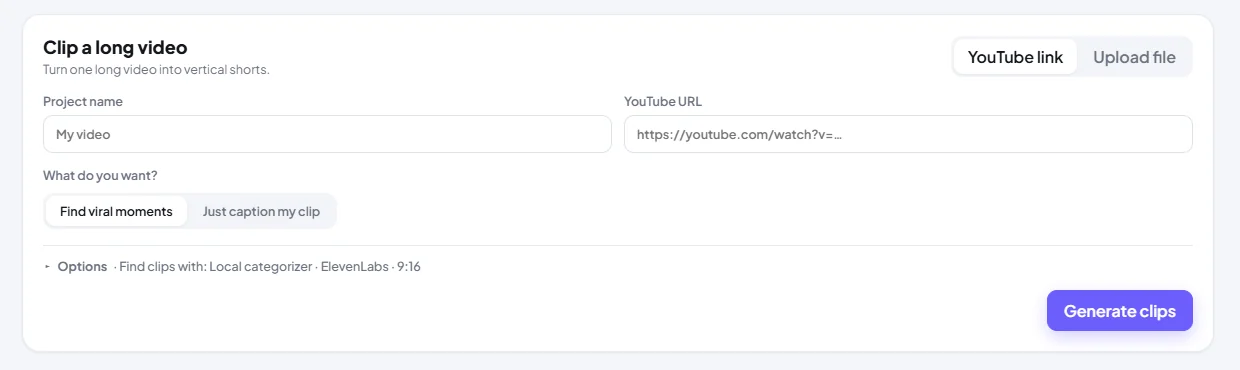
Takes a YouTube link or a video file, transcribes it, scores candidate moments out of 100, reframes each one to 9:16 with face tracking and burns in captions. A full editor handles trimming, caption style and crop before export.

Transcription runs on the CPU with faster-whisper, so it works with no API key at all; adding an OpenAI key lets a model choose the clips instead of the built-in scorer. Windows only, no account.

Opened
2026-07-07
Stack
TypeScript, Python, AI
Cvideo's Clipping screen: paste a YouTube link or upload a file, choose find viral moments or just caption, then generate clips.
Figure 4. Clipping a Long Video in Cvideo

7.1.4 OpenTime: Automatic time tracker for Windows

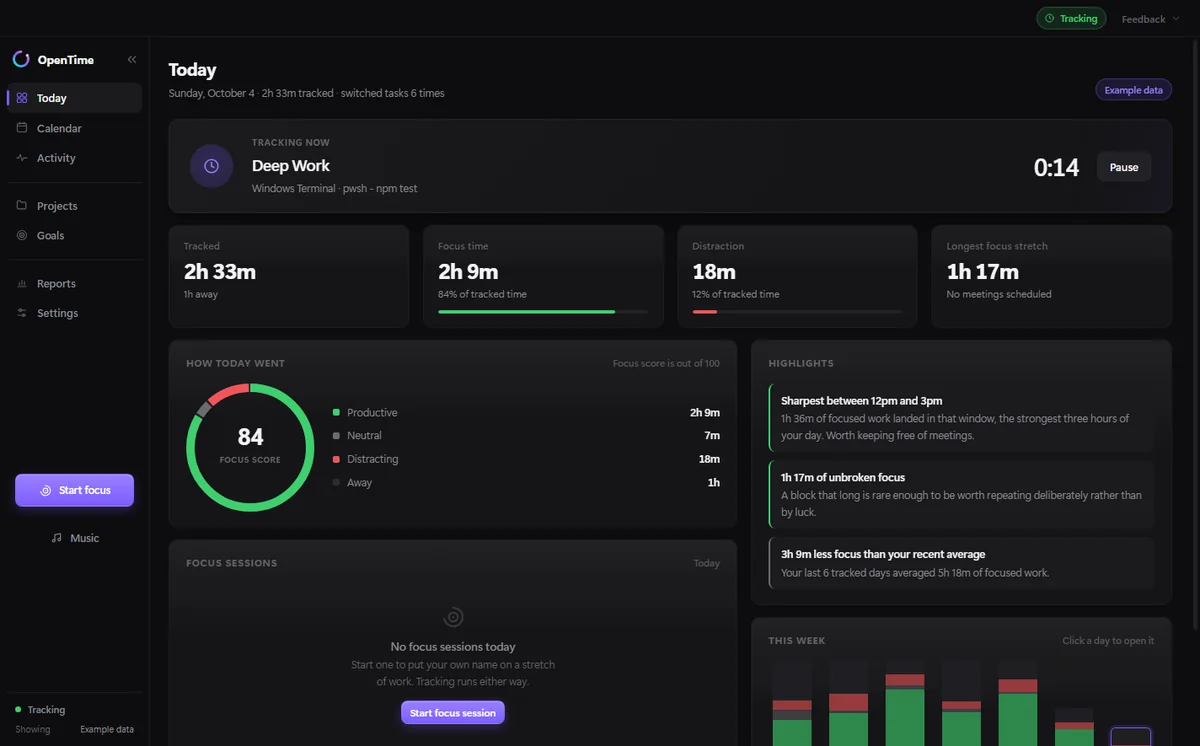
Records which app or website is in front and turns the day into a timeline, a focus score and simple reports. The focus score is the productive share of tracked time. No account, no screenshots, and the data stays on the machine.

Three versioned releases so far: v0.3.0 and v0.3.1 on 26 September 2026 and v0.4.0 on 4 October 2026.

Licence
Apache-2.0
Status
in development
Opened
2026-08-01
Stack
TypeScript, Electron
OpenTime dashboard for today: tracked time, focus time, a focus score of 84, highlights, and a weekly bar chart.
Figure 5. OpenTime Daily Dashboard

7.1.5 Forgey: Describe an app, watch it get built

A dead-simple, local-first desktop app builder in the spirit of Lovable. Pick Claude CLI or Codex CLI, choose a folder, describe an app, and watch it open in a live local preview while the agent writes the files.

No hosted account, no Docker, no vendor backend: your CLI uses its own sign-in and edits your local project. Forgey installs dependencies with lifecycle scripts disabled, runs Vite on localhost and shows a summary of every file added, changed or deleted.

Licence
Apache-2.0
Opened
2026-08-21
Stack
TypeScript, Electron, AI agents
BUILT BY DENNIS DN2026 DNDS001C – JULY 2026 – REVISED OCTOBER 2026

7.1.6 Transcript Snatcher: Bulk YouTube transcripts

A Chrome extension that downloads YouTube transcripts for one video, a pasted list or a whole channel. YouTube rate-limits bulk caption requests, so before each job it tests five separate fetch methods in your own browser session and uses whichever one works right now.

If a method starts failing mid-job it re-tests and switches. The last resort is scraping a hidden tab, which is slow (3 to 6 seconds a video) but keeps working even after YouTube has rate-limited the connection. Manifest V3, no dependencies.

Licence
MIT
Opened
2026-08-05
Stack
JavaScript, Chrome extension

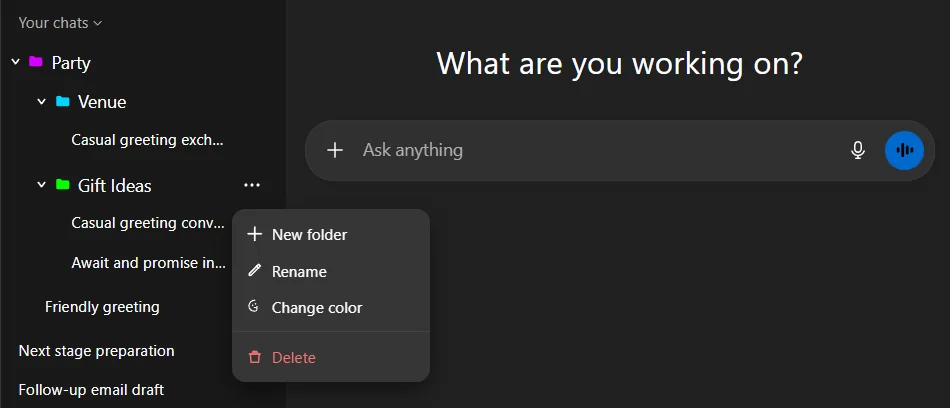
7.1.7 NestFolders: Nested folders for ChatGPT and Claude

Adds nested folders inside the ChatGPT and Claude sidebars, with drag and drop, colours, and a separate folder tree for every chat list. The structure syncs through the Chrome profile and exports as JSON.

This is a fork. I added the Claude integration, a site-adapter layer so one codebase drives both sites, and a test suite that runs the real content scripts in jsdom and in headless Chromium.

Licence
MIT
Opened
2026-08-14
Stack
JavaScript, Chrome extension
Nested folders inside the ChatGPT sidebar, with the folder menu open for new folder, rename, change colour, and delete.
Figure 6. Nested Folders and the Folder Menu in the ChatGPT Sidebar
BUILT BY DENNIS DN2026 DNDS001C – JULY 2026 – REVISED OCTOBER 2026

7.1.8 Pixel Companion: Offline pixel-art desktop companion

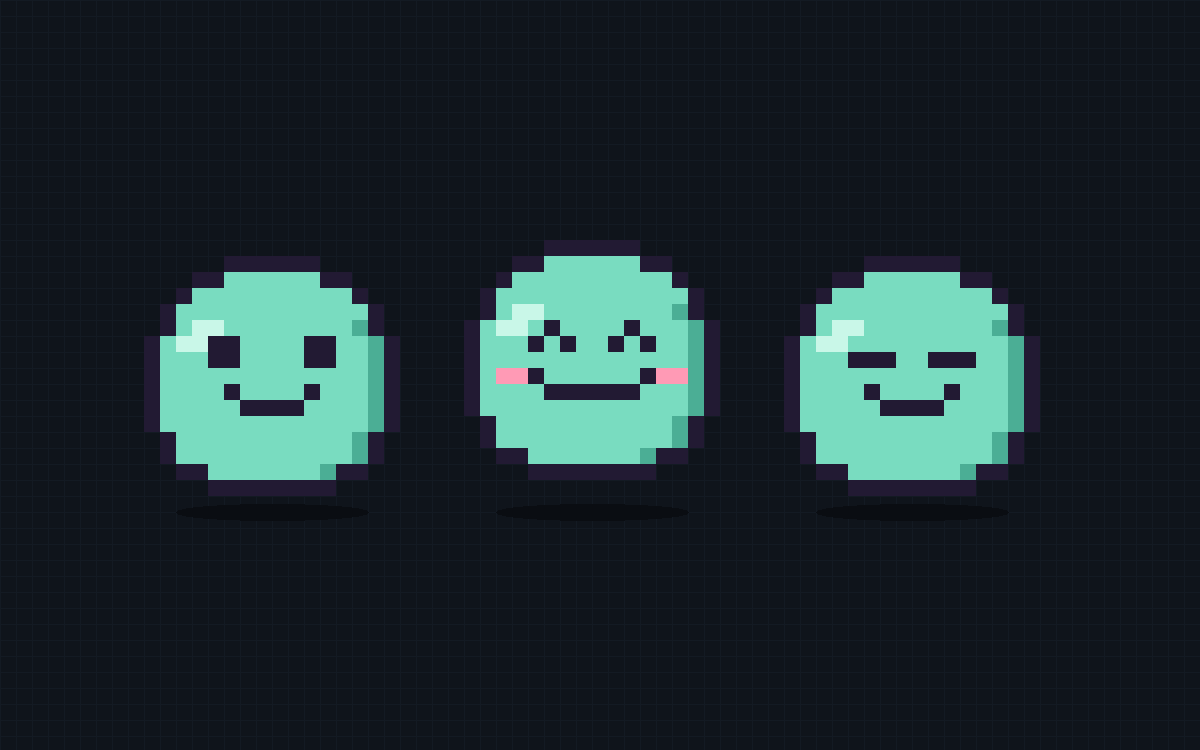
A small pixel creature that sits at the edge of the desktop. Click it to talk; it checks in through the day, including whether you made it to the gym. It is meant for company and light accountability, and it says plainly that it is not therapy.

It runs with the network unplugged: no account, no paid API, no telemetry. Every sprite is drawn by hand as character grids in the source, a 16 by 16 body with a 12 by 5 face stamped on top. A local model server can be switched on, and is off by default.

Licence
MIT
Opened
2026-07-30
Stack
TypeScript, Electron, Local LLM
The Pixel Companion creature in three expressions - idle, happy, and blinking - rendered from its hand-authored sprite data.
Figure 7. Idle, Happy and Blink Expressions, Rendered From the Sprite Source

7.1.9 sudoku-race: Head-to-head Sudoku

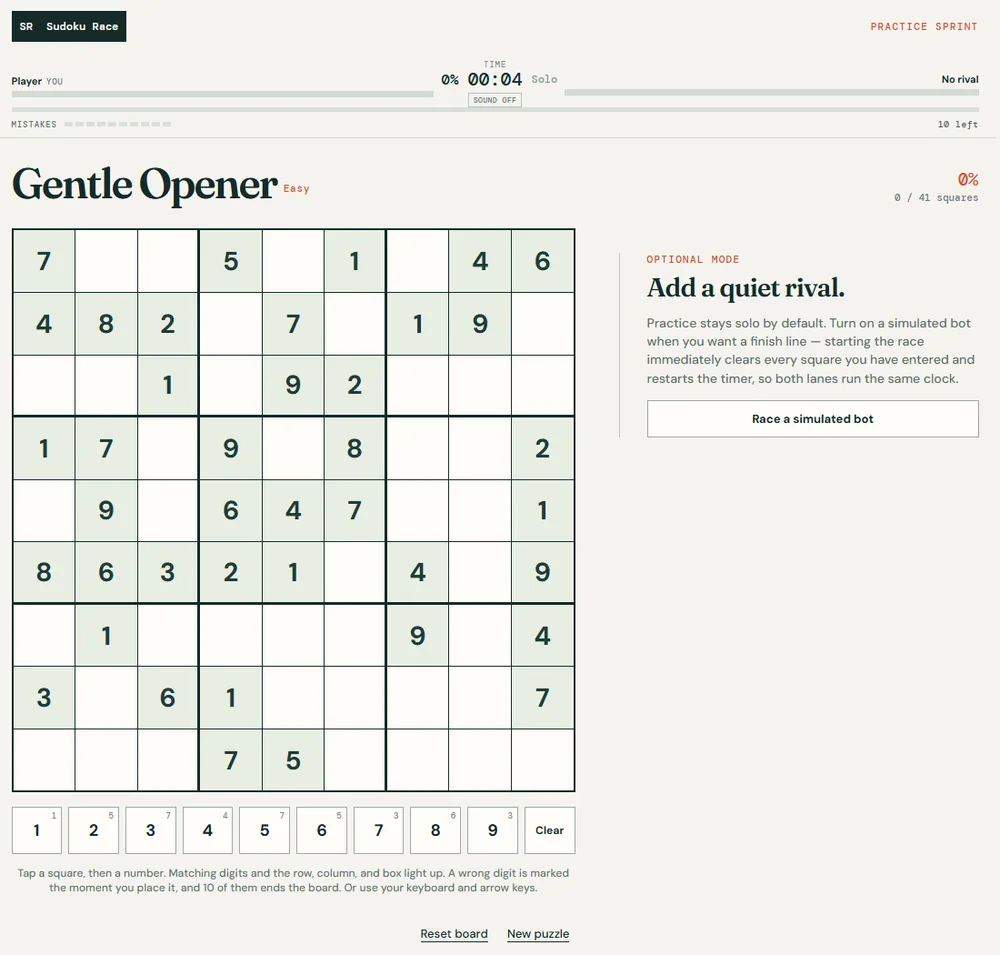
Two players get the same board and race to finish it first. You can also race a simulated bot or play the daily puzzle. No account and no email.

Source
Closed source; details and a demo on request
Stack
TypeScript, Cloudflare Workers
A Sudoku Race practice board mid-game, with the number pad below and a progress bar against your rival above.
Figure 8. Practice Sprint Board
BUILT BY DENNIS DN2026 DNDS001C – JULY 2026 – REVISED OCTOBER 2026

8Device and Documentation Support

8.1Contact

For questions, collaboration, or a demo of one of the closed-source projects, email me.

ElectricSamurai9 [at] gmail (dot) com

8.2Receiving Notification of Updates

8.3Trademarks

ChatGPT is a trademark of OpenAI. Claude is a trademark of Anthropic. YouTube and Chrome are trademarks of Google LLC. Electron is a project of the OpenJS Foundation. All other trademarks are the property of their respective owners. DN2026 is not a real part number; please do not try to order it.

DNDS001C · End of document